
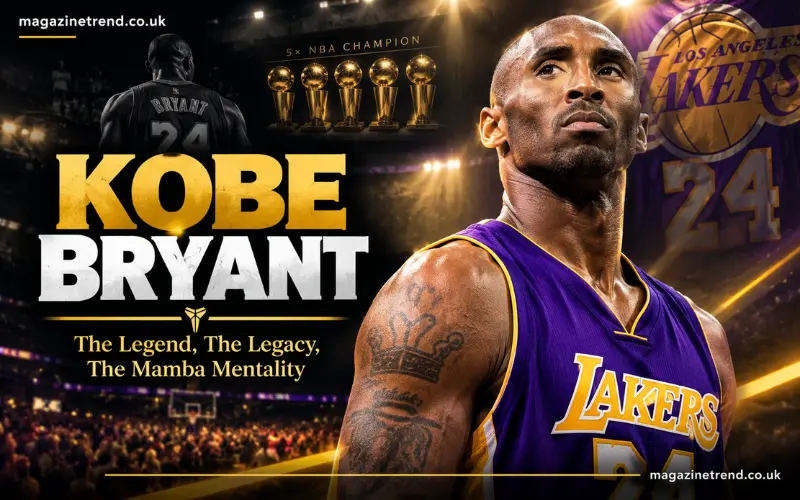
Kobe Bryant was more than a basketball superstar. For millions of fans, he represented the determination to keep improving, the courage to compete under pressure and the belief that excellence comes from consistent effort. Across a 20-season career with the Los Angeles Lakers, Bryant became one of the most recognisable figures in professional basketball.
Known worldwide as the Black Mamba, he won five NBA championships, earned the league’s Most Valuable Player award in 2008 and collected two Olympic gold medals with Team USA. His performances helped define an era of Lakers basketball, while his demanding approach to training became associated with the phrase Mamba Mentality.
Bryant’s influence also extended beyond the court. He explored storytelling and filmmaking, winning an Academy Award for the animated short film Dear Basketball. He later invested time in youth sports and projects designed to encourage young athletes and creators.
His life ended on January 26, 2020, in a helicopter crash in California that also killed his 13-year-old daughter, Gianna, and seven other people. The tragedy shocked the sporting world and brought renewed attention to his family, career and contributions.
This biography explores Kobe Bryant’s early life, rise to NBA greatness, championship years, personal life and the legacy that continues to influence basketball and popular culture.
Kobe Bryant at a Glance
| Detail | Information |
| Full name | Kobe Bean Bryant |
| Date of birth | August 23, 1978 |
| Birthplace | Philadelphia, Pennsylvania, USA |
| Nationality | American |
| Profession | Professional basketball player, filmmaker and entrepreneur |
| NBA team | Los Angeles Lakers |
| NBA career | 1996–2016 |
| Nickname | Black Mamba |
| NBA championships | 5 |
| NBA MVP awards | 1, in 2008 |
| Wife | Vanessa Bryant |
| Date of death | :January 26, 2020 |
| Hall of Fame | Inducted in 2020 |
These details are documented in the NBA’s historical records and the Naismith Memorial Basketball Hall of Fame profile.
Related Post: Alissa Mahler: Education, Career, Husband and Family Life
Early Life: The Experiences That Shaped Kobe Bryant
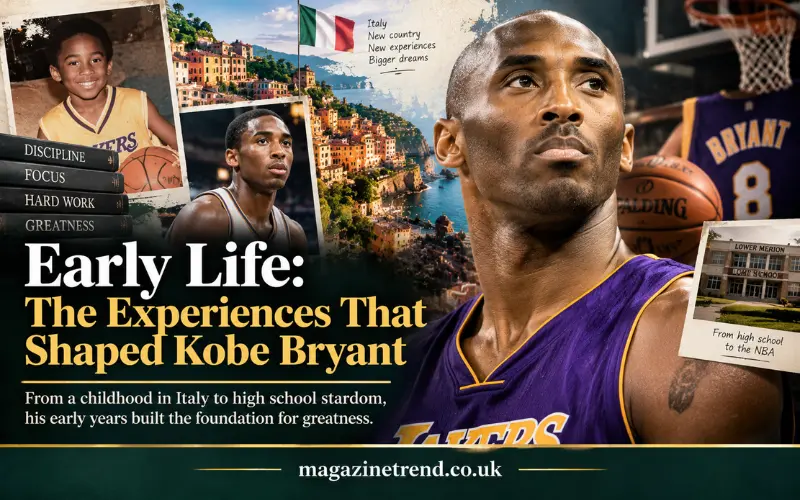
Kobe Bryant was born in Philadelphia on August 23, 1978. Basketball was part of his family background: his father, Joe Bryant, played professional basketball, giving Kobe an early connection to the sport.
When Kobe was a child, his family moved to Italy after his father continued his playing career overseas. Living in a different country exposed him to new languages, cultures and sporting traditions.
Bryant learned to speak Italian and developed an interest in soccer alongside basketball. Although his later reputation was built almost entirely around basketball, his childhood in Europe helped shape his broader outlook.
His family eventually returned to the United States, where Bryant attended Lower Merion High School in Pennsylvania. There, he emerged as one of the country’s most exciting young basketball prospects.
His high-school performances attracted national attention. Rather than attending college before turning professional, Bryant decided to enter the 1996 NBA Draft directly from high school.
That decision was ambitious. Entering the NBA as a teenager meant competing against physically mature professionals while adapting to the pressure of a major sporting stage. Bryant’s confidence, technical ability and competitive instincts helped him make the transition.
How Kobe Bryant Entered the NBA
The Charlotte Hornets selected Bryant with the 13th overall pick in the 1996 NBA Draft. He was subsequently traded to the Los Angeles Lakers, beginning the relationship that would define his professional career.
At just 17 when he was drafted, Bryant was one of the youngest players to enter the league at that time. His first seasons required patience as he learned the pace, physicality and tactical complexity of NBA basketball.
He initially came off the bench, developing his skills against experienced opponents. His performances improved, and his confidence grew as he gained more playing time.
The 1997 Slam Dunk Contest helped introduce his athleticism to a wider audience. Yet his rise was not simply a story of natural talent. Bryant became known for studying opponents, practising difficult shots and repeatedly working on weaknesses.
His partnership with Shaquille O’Neal became one of the defining relationships of his early career. O’Neal brought extraordinary size and interior dominance, while Bryant offered perimeter scoring, quick footwork and the ability to create shots under pressure.
Together, they helped the Lakers become one of the NBA’s most formidable teams at the turn of the millennium.
Kobe Bryant’s Championship Years With the Lakers
Bryant’s first major championship breakthrough came in 2000, when the Lakers defeated the Indiana Pacers in the NBA Finals. It was the beginning of a three-year championship run that established the team as a dominant force.
The Lakers won again in 2001 and 2002, with Bryant becoming an increasingly important part of the team’s offensive identity.
Although O’Neal received the Finals MVP award during all three championship seasons, Bryant’s performances in key playoff games demonstrated that he was much more than a supporting player.
The relationship between the two stars was complicated at times. Both were highly competitive, and disagreements attracted considerable media attention. Nevertheless, their complementary abilities produced a successful partnership that helped reshape the Lakers’ place in NBA history.
After the team separated its two-star partnership, Bryant entered a period in which he carried a greater share of the scoring responsibility. His individual performances remained spectacular, but championship success did not immediately follow.
The arrival of Pau Gasol in 2008 helped change that situation. Bryant and Gasol developed an effective partnership, taking the Lakers to three consecutive NBA Finals from 2008 through 2010.
The Lakers lost to the Boston Celtics in 2008 before winning championships in 2009 and 2010. Bryant earned Finals MVP honours in both championship victories.
Those titles completed his collection of five NBA championships and strengthened his reputation as one of the defining players of his generation.
Kobe Bryant’s Five NBA Championships
| Season | NBA Finals opponent | Result | Key context |
| 1999–2000 | Indiana Pacers | Lakers won 4–2 | First NBA championship |
| 2000–2001 | Philadelphia 76ers | Lakers won 4–1 | Second consecutive title |
| 2001–2002 | New Jersey Nets | Lakers won 4–0 | Championship three-peat completed |
| 2008–2009 | Orlando Magic | Lakers won 4–1 | Bryant earned Finals MVP |
| 2009–2010 | Boston Celtics | Lakers won 4–3 | Back-to-back titles completed |
These five championships illustrate the different stages of Bryant’s career: his emergence beside O’Neal and his later leadership of a Lakers team built around his scoring and experience.
Related Post: Janai Norman: Biography, Age, Husband, Children and Career
The 81-Point Game That Became Basketball History
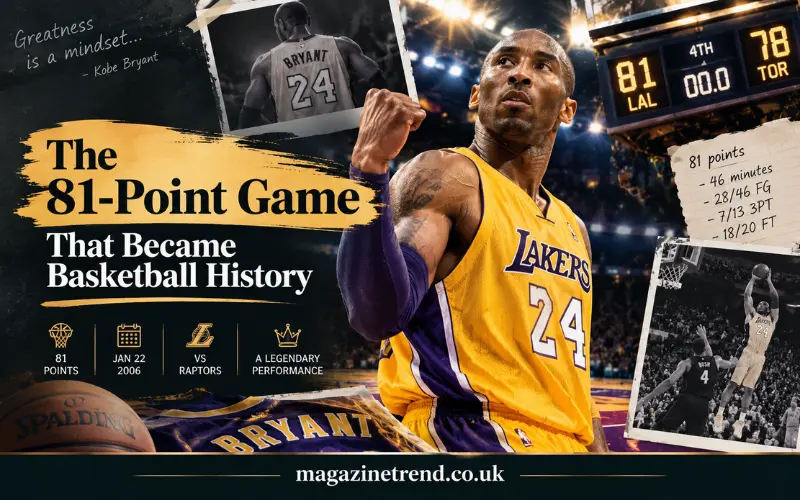
On January 22, 2006, Bryant scored 81 points against the Toronto Raptors in a regular-season game. It remains one of the most remarkable individual scoring performances in NBA history.
The Lakers eventually won 122–104 after Bryant produced an extraordinary offensive display. He scored from several areas of the court, attacking the basket, hitting jump shots and converting free throws.
The significance of the performance extended beyond the final number. Bryant had to keep scoring as the Lakers attempted to overcome a difficult position in the game. His ability to sustain that level of production over four quarters demonstrated his concentration and offensive range.
Only Wilt Chamberlain’s 100-point game in 1962 stands above Bryant’s 81-point performance in the NBA’s single-game scoring record books.
The achievement remains a central part of his career because it captures several defining features of his game: footwork, shot creation, stamina and an extraordinary willingness to take responsibility when his team needed points.
Bryant also led the NBA in scoring during the 2005–06 and 2006–07 seasons. Those campaigns established him as one of the league’s most productive offensive players of the period.
Understanding Kobe Bryant’s Mamba Mentality
The phrase Mamba Mentality became closely associated with Bryant’s approach to basketball and personal development. It represented his emphasis on preparation, discipline, adaptability and the willingness to improve.
For Bryant, success was not limited to what happened during a game. Preparation mattered because it allowed a player to respond to pressure with confidence. Repetition mattered because it helped turn difficult skills into reliable habits.
His training routines became widely discussed, but the broader idea was more significant than any single workout. Bryant encouraged athletes to examine their weaknesses rather than relying exclusively on their strengths.
The philosophy can be understood through several principles.
Preparation Before Performance
Bryant placed considerable emphasis on preparation. Studying opponents, practising specific movements and understanding game situations helped him anticipate what might happen on the court.
This approach is relevant beyond sports. Preparation gives people more options when circumstances become unpredictable.
Learning From Failure
Bryant’s career included disappointing playoff defeats, injuries and seasons when the Lakers failed to reach their ultimate goal. His public image often emphasised responding to setbacks through renewed effort.
That attitude did not make failure disappear. Instead, it encouraged examining mistakes and using them as opportunities to improve.
Adaptability Over Time
A player’s role can change with age, injuries and the strengths of teammates. Bryant adapted his game across different stages of his career, moving from a young athletic guard into an experienced scorer who relied heavily on footwork, timing and shot-making.
His career offers an example of how improvement requires more than repeating the same approach. It also requires recognising when a different strategy is needed.
Applying the Philosophy Outside Basketball
The Mamba Mentality became popular among athletes, students, entrepreneurs and people working toward demanding personal goals.
Its most useful interpretation is not that people must work without rest or sacrifice every other part of life. Rather, it emphasises deliberate preparation, consistent practice, honest self-evaluation and a willingness to keep learning.
Bryant’s own career also showed that even extraordinary dedication cannot prevent every injury, defeat or disappointment. The philosophy is most valuable when treated as a guide to effort, not a promise of guaranteed success.
Kobe Bryant’s Career Statistics and Major Awards
Bryant’s achievements can be measured through championships and awards, but his regular-season statistics also illustrate his consistency.
Across 1,346 regular-season games, he averaged 25.0 points, 5.2 rebounds and 4.7 assists per game. He spent his entire 20-season NBA career with the Lakers.
He was selected to 18 All-Star teams and earned 15 All-NBA selections. His defensive contributions were also recognised, with 12 All-Defensive Team selections.
In 2008, Bryant won the NBA Most Valuable Player award. He had already established himself as an elite scorer, but the award recognised his influence on the Lakers during a season in which the team returned to the top of the Western Conference.
His career also included two NBA Finals MVP awards and two Olympic gold medals with the United States men’s basketball team, earned in Beijing in 2008 and London in 2012.
Major Career Achievements
| Achievement | Total or year | Why it matters |
| NBA championships | 5 | Demonstrated sustained team success |
| NBA regular-season MVP | 2008 | Recognised as the league’s most valuable player |
| NBA Finals MVP | 2 | Earned in 2009 and 2010 |
| NBA All-Star selections | 18 | Reflected long-term recognition |
| Olympic gold medals | 2 | Won in 2008 and 2012 |
| NBA career points | 33,643 | Placed him among the league’s most prolific scorers |
| Hall of Fame induction | 2020 | Recognised his historic contribution to basketball |
Bryant’s career ended in 2016, but his place in basketball history continued to be recognised after his retirement.
The Final NBA Game: A Memorable Goodbye
On April 13, 2016, Bryant played the final game of his NBA career against the Utah Jazz.
Rather than quietly stepping away, he delivered a performance that captured the attention of basketball fans around the world. Bryant scored 60 points in the Lakers’ 101–96 victory.
The game became an emotional farewell to a player who had represented the same franchise for two decades. The crowd responded to his scoring runs, while teammates repeatedly looked for opportunities to get him the ball.
Bryant scored 23 points in the fourth quarter, helping the Lakers turn the game around. His final performance was not simply a statistical achievement; it was a dramatic conclusion to a career defined by difficult shots and confidence in high-pressure moments.
At the final buzzer, he addressed the crowd and ended his remarks with the phrase “Mamba out.” The words became a lasting part of his public legacy.
His retirement also marked the end of an era for the Lakers. Few players have represented a single NBA franchise for as long or become as closely identified with its history.
Related Post: David Bromstad Twin Brother: The Truth About His Family
Life Beyond Basketball: Film, Business and Storytelling

Bryant’s ambitions expanded beyond sport as his playing career progressed. He explored projects that allowed him to communicate with audiences in different ways.
One of his most notable achievements came through Dear Basketball, an animated short film inspired by the letter he wrote announcing his retirement. The film won the Academy Award for Best Animated Short Film in 2018.
The award showed that Bryant’s interests extended into creative production and storytelling. Rather than simply licensing his name to a project, he became involved in developing a story about his relationship with the sport.
He also founded Granity Studios, a company focused on storytelling across different media. Its projects included books and content intended to engage young readers and audiences interested in sport, imagination and personal development.
Bryant’s work in this area suggested that he wanted to build a second professional identity after basketball. His achievements as a player gave him a global audience, but his creative projects allowed him to explore subjects that could reach people who were not necessarily sports fans.
His post-retirement career was still developing when he died in 2020. The projects he completed, however, remain part of his broader professional legacy.
Kobe Bryant’s Wife, Vanessa Bryant and Family Life
Kobe Bryant married Vanessa Laine in 2001. Their relationship was frequently covered by entertainment and sports media, but much of their family life remained separate from his public career.
The couple had four daughters: Natalia, Gianna, Bianka and Capri.
Gianna, often known as Gigi, shared her father’s passion for basketball. Kobe supported her development as a player and became involved in conversations about the future of women’s basketball.
He spoke publicly about coaching and helping young players, and Gianna’s ambition became an important part of his later life. Their shared interest in the game was visible at basketball events and in family appearances.
The loss of Kobe and Gianna in January 2020 had a profound impact on Vanessa and the wider family. In the years that followed, Vanessa has continued to honour their memories through public tributes and charitable initiatives.
The family has also been associated with the Mamba and Mambacita Sports Foundation, which supports opportunities for young athletes, particularly girls and underserved communities.
Although public interest in the Bryant family remains high, it is important to distinguish verified information from rumours about their private lives. Their family story deserves respectful coverage rather than speculation.
Kobe Bryant’s Death and the Global Response
Kobe Bryant died on January 26, 2020, in a helicopter crash in Calabasas, California. His daughter Gianna and seven other people also died in the crash.
The news prompted an immediate response across professional sports, entertainment and public life. Players, coaches, teams and fans shared tributes, reflecting Bryant’s impact beyond the Lakers organisation.
Memorials appeared at basketball arenas and public spaces. The NBA community honoured his contribution to the game, while fans revisited highlights and celebrated the moments that had defined his career.
The loss was especially significant because Bryant had only recently retired and was pursuing new creative and family projects. His post-basketball life was still unfolding, leaving many people to reflect on what he might have achieved in the years ahead.
In 2020, Bryant was posthumously inducted into the Naismith Memorial Basketball Hall of Fame. His recognition reflected a career that combined championship success, individual excellence and a lasting influence on the sport.
The tragedy should not overshadow his full life story. His basketball achievements, creative work and family commitments form a broader picture of a person whose public identity included much more than his final moments.
Kobe Bryant’s Lasting Influence on Basketball
Bryant’s legacy is visible in the way younger players study his techniques and discuss his approach to competition. His footwork, fadeaway jumper and ability to create a shot under pressure remain important reference points for aspiring guards.
His influence also reaches beyond technical basketball skills. The Mamba Mentality encouraged athletes to take preparation seriously and to approach improvement as an ongoing process.
The retirement of his jersey numbers, 8 and 24, by the Lakers in December 2017 represented his impact on the franchise. Both numbers had become associated with different stages of his career, from his explosive early years to his later leadership.
Bryant’s legacy has also been recognised through the NBA All-Star Game MVP award, which was renamed the Kobe Bryant NBA All-Star Game MVP Award in his honour.
His contribution to basketball is not measured by statistics alone. He became a cultural figure whose career connected generations of fans, from those who watched his first Lakers seasons to younger audiences who discovered his highlights and training philosophy later.
At the same time, a balanced legacy should acknowledge that public figures can be complex and that no single phrase or award captures an entire life. Bryant’s sporting achievements remain extraordinary, while his wider story includes family, creative ambitions, challenges and the consequences of a life lived under intense public attention.
FAQs
How many NBA championships did Kobe Bryant win?
Kobe Bryant won five NBA championships with the Los Angeles Lakers. He won three consecutive titles from 2000 through 2002, followed by championships in 2009 and 2010.
What was Kobe Bryant’s age when he died?
Bryant was 41 years old when he died on January 26, 2020. He was born on August 23, 1978.
Who was Kobe Bryant’s wife?
Kobe Bryant was married to Vanessa Bryant. They married in 2001 and had four daughters: Natalia, Gianna, Bianka and Capri.
What does Mamba Mentality mean?
Mamba Mentality refers to Bryant’s emphasis on preparation, discipline, adaptability and continuous improvement. It became a widely recognised expression of his approach to basketball and personal development.
How many points did Kobe Bryant score in his highest-scoring NBA game?
Bryant scored 81 points against the Toronto Raptors on January 22, 2006. It is the second-highest individual scoring total in a single NBA game, behind Wilt Chamberlain’s 100 points.
Did Kobe Bryant win an Oscar?
Yes. Bryant won the Academy Award for Best Animated Short Film in 2018 for Dear Basketball, a film inspired by his retirement letter and his relationship with the sport.
Conclusion
Kobe Bryant’s story combines exceptional sporting achievement with a lasting influence on how athletes think about preparation and improvement. Over 20 seasons with the Los Angeles Lakers, he won five championships, became the 2008 NBA MVP and established himself as one of basketball’s most accomplished scorers.
His career also extended beyond the court. Through Dear Basketball, Granity Studios and youth-focused projects, Bryant explored storytelling and opportunities to inspire younger generations.
His death in 2020 was a devastating loss for his family, the basketball community and fans around the world. Yet his achievements remain part of NBA history, while the Mamba Mentality continues to influence discussions about dedication and personal growth.
A meaningful account of Kobe Bryant recognises both his extraordinary career and the wider life he was building. His legacy is found in championship banners and record books, but also in the players who study his game, the stories he helped create and the people who continue to draw motivation from his approach to pursuing excellence.
