

Few athletes have built a reputation as unusual as Bo Jackson. At a time when professional sports increasingly demanded complete commitment to a single discipline, Jackson pursued two of America’s biggest sporting leagues: Major League Baseball and the National Football League.
He was a powerful running back who could break away from defenders and a baseball outfielder capable of hitting towering home runs. Before reaching professional fame, he won college football’s most prestigious individual award. Later, a Nike advertising campaign turned his name into a cultural catchphrase: “Bo Knows.”
Yet Jackson’s story is not simply about extraordinary physical ability. It is also about the challenges of balancing two professional careers, the consequences of a serious injury and the determination required to return to elite competition.
Born Vincent Edward Jackson in Bessemer, Alabama, on November 30, 1962, he became one of the most memorable sporting figures of the late 1980s and early 1990s. His professional career was shorter than many expected, but his achievements across football and baseball created a legacy that still attracts attention.
This article explores Bo Jackson’s rise from Alabama to national recognition, his accomplishments in two sports, the injury that changed his career and the reasons his name remains relevant decades after his final professional game.
Bo Jackson at a Glance
| Detail | Information |
| Full name | Vincent Edward Jackson |
| Known as | Bo Jackson |
| Date of birth | November 30, 1962 |
| Birthplace | Bessemer, Alabama, USA |
| Main sports | American football and baseball |
| College | Auburn University |
| College football honour | 1985 Heisman Trophy |
| NFL team | Los Angeles Raiders |
| MLB teams | Kansas City Royals, Chicago White Sox, California Angels |
| Famous nickname | Bo Knows |
| Wife | Linda Jackson |
| Children | Public biographies report three children |
| Known for | Competing professionally in two major American sports |
Related Post: Kobe Bryant: Biography, NBA Career, Family and Lasting Legacy
Growing Up in Alabama: Before the World Knew Bo

Bo Jackson grew up in Alabama, where athletics eventually became a major part of his life. His early sporting development took place long before advertising campaigns and professional contracts made him a household name.
At McAdory High School, Jackson displayed an impressive combination of speed, strength and coordination. He competed in multiple sports, including football, baseball and track and field. His versatility made him an attractive prospect to college recruiters.
His talent was not limited to one position or event. In football, he showed the ability to accelerate through openings and break tackles. On the baseball diamond, his power and athleticism attracted attention from scouts.
Jackson’s high-school achievements helped him earn opportunities at the next level. The New York Yankees selected him in the 1982 MLB amateur draft, but he chose to attend Auburn University instead.
That decision proved significant. Auburn offered Jackson the opportunity to continue developing as a football player while pursuing his education and competing in college baseball.
His early life is an important part of the story because it shows that his two-sport reputation did not emerge suddenly in the professional leagues. The foundation was built through years of competing in different environments and developing skills that could transfer from one sport to another.
Auburn University and the Heisman Trophy
Auburn University became the setting for Jackson’s breakthrough as a national sporting star. Playing college football in the Southeastern Conference placed him against high-level competition and gave his performances a substantial audience.
Jackson’s combination of acceleration, power and balance made him difficult to contain. He could turn an ordinary running play into a major gain, forcing opposing defences to account for his ability to break away.
His most celebrated college season came in 1985. Jackson’s performances helped establish him as one of the leading players in the country, and he won the Heisman Trophy, awarded annually to college football’s most outstanding player.
The award was a major milestone, but it also complicated his future plans. Professional football teams wanted his services, while baseball remained a genuine alternative.
The Tampa Bay Buccaneers selected Jackson first overall in the 1986 NFL Draft. However, a dispute surrounding his visit to the team’s facilities and his college eligibility influenced his decision not to sign with Tampa Bay.
Instead, Jackson entered professional baseball with the Kansas City Royals, who had selected him in the fourth round of the 1986 MLB Draft.
His decision demonstrated how unusual his career path was. A player with the credentials to be the first selection in the NFL Draft was prepared to pursue baseball rather than accept a conventional football career.
Bo Jackson’s Early Milestones
| Year | Milestone | Significance |
| 1982 | Selected by the New York Yankees in the amateur draft | Baseball scouts recognised his potential early |
| 1985 | Won the Heisman Trophy | Reached the top of college football |
| 1986 | Selected first overall by Tampa Bay in the NFL Draft | Established his value as a football prospect |
| 1986 | Drafted by the Kansas City Royals | Began his professional baseball journey |
| 1986 | Made his MLB debut | Reached the major leagues |
Why Bo Jackson Chose Professional Baseball First
Jackson’s decision to begin his professional career in baseball is one of the defining moments of his biography.
After the Buccaneers selected him, Jackson did not sign with the team. He subsequently joined the Kansas City Royals organisation and made his major-league debut on September 2, 1986.
Baseball provided a different route into professional sport. It also allowed Jackson to pursue an ambition that had existed alongside football since his school years.
The decision was not without risk. Professional baseball required a different rhythm, technical approach and season-long commitment. Unlike football, where explosive plays can define a player’s reputation quickly, baseball demands repeated performance through a long schedule.
Jackson adapted and became a productive outfielder. His combination of speed and power made him an exciting player to watch, and he eventually established himself as a significant contributor to Kansas City.
He also maintained his interest in football. In 1987, Jackson joined the Los Angeles Raiders, creating the unusual arrangement that would define his professional identity.
His baseball commitments meant that his availability for football differed from that of a typical NFL player. The arrangement required coordination between seasons and careful management of his responsibilities in two demanding leagues.
Rather than viewing one sport as a temporary diversion, Jackson treated both as serious professional pursuits. That decision helped create the dual-sport career that made him famous.
Related Post: Alissa Mahler: Education, Career, Husband and Family Life
Bo Jackson’s NFL Career With the Los Angeles Raiders
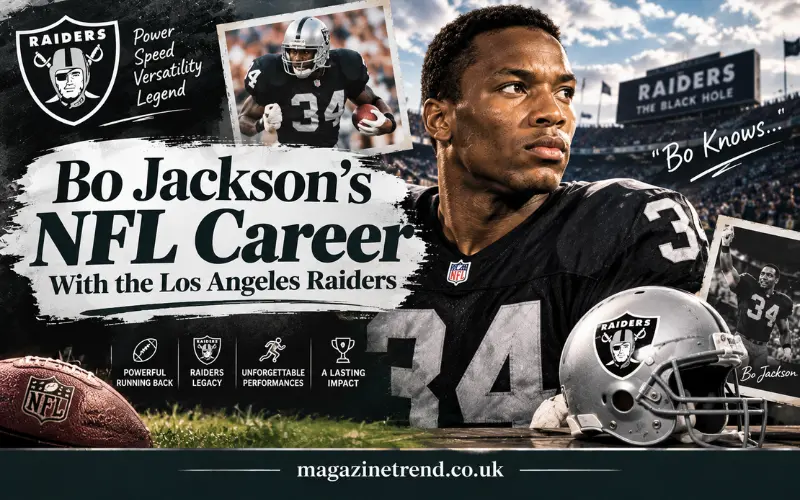
Jackson began playing for the Los Angeles Raiders in 1987. His time with the franchise was relatively brief, but his performances created some of the most memorable highlights of his football career.
He played as a running back, a position that demands acceleration, balance, vision and the ability to withstand contact. Jackson possessed a rare combination of those qualities.
The Raiders’ official career record credits him with 2,782 rushing yards and 16 rushing touchdowns across 38 games. His average of 5.4 yards per rushing attempt reflects the explosive nature of his performances.
The 221-Yard Performance
One of Jackson’s most impressive NFL performances came against the Seattle Seahawks in 1987, when he rushed for 221 yards.
That performance demonstrated his ability to contribute at a high level even while maintaining a baseball career. It also helped establish his reputation among football fans who might not have followed his college career.
Jackson was especially dangerous when he reached open space. His speed allowed him to turn a gap in the defence into a long gain, while his strength made him difficult to bring down once he built momentum.
The Long Runs That Became Highlights
Jackson recorded famous long touchdown runs during his time with the Raiders, including a 91-yard run in 1987 and a 92-yard run in 1989.
These plays became part of his sporting identity because they captured what made him unusual: the ability to combine the size of a power runner with the speed needed to outrun defenders.
His football career was short, and his statistics do not match the totals accumulated by running backs who played for a decade or more. Nevertheless, his performances left a lasting impression because he could produce spectacular results in limited opportunities.
Bo Jackson’s NFL Statistics
| NFL statistic | Career total |
| Games played | 38 |
| Rushing attempts | 515 |
| Rushing yards | 2,782 |
| Average yards per carry | 5.4 |
| Rushing touchdowns | 16 |
| Longest recorded rush | 92 yards |
Statistics are based on the NFL’s career records for Jackson.
Bo Jackson’s Baseball Career: Power, Speed and the Royals
Although Jackson is often remembered for his football highlights, his baseball career deserves equal attention.
He made his MLB debut with the Kansas City Royals in 1986 and developed into an outfielder known for power hitting and athletic defence. He could hit home runs, cover ground and create excitement with his combination of speed and strength.
His strongest season came in 1989. Jackson hit 32 home runs and drove in 105 runs, while also stealing 26 bases. That combination of power and speed made him one of the most distinctive players in baseball at the time.
His performance earned him a place in the 1989 MLB All-Star Game. He was named All-Star Game MVP after hitting a home run in his first at-bat and contributing to the American League’s victory.
The home run became one of the most celebrated moments of his baseball career. It travelled an estimated 448 feet, illustrating the power that made Jackson such a compelling player.
He continued to produce strong results in 1990, hitting 28 home runs for Kansas City.
What Made Jackson Different on a Baseball Field?
Jackson’s athleticism allowed him to contribute in several ways. His power could change a game with one swing, while his speed made him a threat on the bases and in the outfield.
His physical abilities did not eliminate the need for baseball technique. Hitting professional pitching requires timing, judgement and consistent mechanics, while playing the outfield demands positioning and reliable decision-making.
Jackson developed into a productive major-league player despite balancing baseball with football. His career was interrupted by injury, but his achievements established him as one of the rare athletes to reach All-Star status in two major professional sports.
Bo Jackson’s MLB Career by the Numbers
| Statistic or achievement | Record |
| MLB debut | September 2, 1986 |
| MLB teams | 3 |
| Career home runs | 141 |
| Career runs batted in | 415 |
| Career hits | 598 |
| Career stolen bases | 82 |
| Career batting average | .250 |
| All-Star Game MVP | 1989 |
These figures cover Jackson’s major-league career with the Royals, White Sox and California Angels.
Related Post: Janai Norman: Biography, Age, Husband, Children and Career
“Bo Knows”: How a Nike Campaign Turned an Athlete Into a Cultural Icon

Bo Jackson’s fame extended beyond the people who watched football and baseball. During the late 1980s and early 1990s, Nike’s “Bo Knows” campaign presented him as an athlete capable of taking on almost any sport.
The advertisements featured Jackson in a variety of sporting settings, using humour and his genuine versatility to promote cross-training shoes.
The campaign worked because it drew on something audiences had already seen. Jackson was not simply being marketed as a talented athlete; he was competing in two professional leagues, giving the campaign a real foundation.
The slogan became part of popular culture. It helped make Jackson recognisable to people who might not have followed the Raiders or the Royals closely.
The campaign also reflected a broader change in sports marketing. Athletes were increasingly becoming cultural figures whose appeal extended into advertising, television and consumer products.
Jackson’s image was particularly suited to that shift. His physical versatility made the campaign memorable, while his performances gave the message credibility.
However, the slogan should not overshadow the sporting work behind the image. The public saw spectacular highlights and humorous advertisements, but his career also involved training, preparation, travel and the challenge of switching between two different professional environments.
The Injury That Changed Everything
On January 13, 1991, Jackson suffered a serious hip injury during a Raiders playoff game against the Cincinnati Bengals.
The injury occurred after a run in the AFC divisional playoff round. It proved career-changing because it affected his ability to play football and threatened his future in baseball.
The Kansas City Royals released Jackson in the spring of 1991. He later joined the Chicago White Sox organisation and returned to MLB action that year.
His hip condition deteriorated, and he underwent hip replacement surgery in April 1992. For an athlete whose game depended heavily on speed and explosive movement, the prospect of returning to professional competition after such an injury was daunting.
Jackson missed the 1992 MLB season but eventually returned to the major leagues. He played for the White Sox in 1993 and the California Angels in 1994, using a prosthetic hip.
His return was remarkable, but it did not restore the career he might otherwise have had. The injury ended his NFL career and limited the remaining years of his baseball career.
The episode also shows why his story is more complex than a highlight reel. His achievements were extraordinary, but elite athletic careers can be changed abruptly by injuries that no amount of talent can fully prevent.
Bo Jackson’s Comeback: Playing Baseball After Hip Replacement
Jackson’s return to baseball after hip replacement surgery was one of the most unusual chapters in his career.
He came back to the major leagues with the Chicago White Sox in 1993, then played for the California Angels in 1994. His ability to return at all was a significant achievement, given the demands of professional baseball and the seriousness of his injury.
His later performances were not a continuation of his peak years. He could no longer rely on the same level of mobility, and his time on the field was limited.
Nevertheless, his return challenged expectations about what was possible after a major hip injury. It also allowed him to finish his playing career on his own terms rather than having the 1991 injury become the final chapter.
Jackson’s last major-league game came on August 10, 1994. By then, his career had included a Heisman Trophy, NFL highlights, an MLB All-Star Game MVP award and a comeback after hip replacement.
Few athletes have experienced such a varied professional journey.
Bo Jackson’s Family and Life Outside Sports
Jackson has generally maintained a more private personal life than his sporting fame might suggest. He is married to Linda Jackson, and public biographies report that they have three children.
Unlike some former athletes who remain prominent in entertainment or regular sports broadcasting, Jackson has not made his private family life the centre of his public identity.
His post-playing life has included business interests and community-related activities. He has also been associated with sports and fitness projects, including the Bo Jackson Elite Sports Complex.
His experience as a two-sport athlete continues to be a central part of his public identity, but his later years have not been limited to looking back at old highlights.
For readers searching for his family details, exact information should be handled carefully. Personal information published by entertainment websites is not always supported by reliable documentation, and there is little reason to repeat private details that do not add meaningful context to his biography.
The clearest picture is of an athlete who became famous for his sporting achievements while keeping much of his family life away from the spotlight.
Bo Jackson’s Net Worth: What Can Be Confirmed?
Bo Jackson’s net worth is a popular search topic, but an exact personal figure cannot be confirmed from reliable public financial records.
His professional football and baseball careers, endorsements and later business activities all contributed to his earning potential. The “Bo Knows” campaign in particular made him a prominent figure in sports marketing.
However, estimates published online vary, and many do not explain their calculations or identify verifiable financial records.
An athlete’s contracts and endorsement deals also do not provide a complete picture of personal wealth. Taxes, investments, business expenses, spending and other financial circumstances affect the final amount.
For these reasons, an exact net-worth figure should not be presented as established fact without strong supporting evidence.
It is fair to say that Jackson built several professional and commercial opportunities from his sporting success. It is not responsible to assign him a precise fortune based solely on unsourced online estimates.
Why Bo Jackson’s Legacy Is Different From Other Sports Legends
Many elite athletes are remembered for a particular season, championship or record. Jackson’s reputation developed differently because his career crossed two professional sports.
He was a Heisman Trophy winner who became an NFL running back and an MLB outfielder. His public image combined football’s explosive running plays with baseball’s power hitting, creating a rare sporting identity.
His career also highlighted the demands of competing professionally in more than one discipline. Football and baseball have different schedules, techniques and physical requirements. Jackson’s ability to reach elite levels in both made his career exceptional even before the injury.
The injury, meanwhile, became a defining turning point. It ended his football career and shortened his baseball career, but it did not erase the achievements he had already made or the comeback that followed.
Jackson’s influence is also visible in how modern audiences talk about multi-sport athletes. His story remains a reference point in discussions about versatility, athletic potential and the risks of pursuing multiple elite careers at once.
He did not accumulate the longest career statistics in either league. Instead, he left a distinctive legacy built around the quality of his performances, his cultural impact and the rarity of what he accomplished.
FAQs
What is Bo Jackson famous for?
Bo Jackson is famous for playing professional football and baseball, winning the 1985 Heisman Trophy and becoming an MLB All-Star Game MVP in 1989. He also became widely known through Nike’s “Bo Knows” campaign.
Did Bo Jackson play in both the NFL and MLB?
Yes. Jackson played NFL football for the Los Angeles Raiders and major-league baseball for the Kansas City Royals, Chicago White Sox and California Angels.
Did Bo Jackson win the Heisman Trophy?
Yes. Jackson won the Heisman Trophy in 1985 while playing college football at Auburn University.
What happened to Bo Jackson’s hip?
Jackson suffered a serious hip injury during a Raiders playoff game in January 1991. The injury ended his NFL career and eventually led to hip replacement surgery in April 1992. He later returned to professional baseball.
Is Bo Jackson still involved in sports?
Jackson has remained associated with sports through business and fitness-related interests, although he is no longer a professional player. His name also continues to feature in historical discussions of two-sport athletes.
What is Bo Jackson’s net worth?
His exact net worth has not been reliably verified through public financial records. Online estimates should be treated as estimates rather than confirmed financial information.
Conclusion
Bo Jackson’s career stands apart because he achieved elite status in two professional sports during the same era. His Heisman Trophy, NFL rushing performances, MLB home runs and 1989 All-Star Game MVP award each tell part of the story.
But his legacy is not limited to numbers. The “Bo Knows” campaign made him a cultural icon, while his recovery from a serious hip injury demonstrated a different kind of determination.
His professional career ended earlier than many fans would have expected, yet the combination of talent, versatility and cultural influence ensured that his name remained memorable.
Bo Jackson did not need a decades-long career in either football or baseball to establish a unique place in American sports history. He became a symbol of what can happen when rare athletic ability meets ambition—and of how a single injury can change even the most promising career.
For readers discovering his story today, the most striking fact is not simply that he played two sports. It is that he became a genuine star in both, leaving a legacy that remains difficult to replicate.
