
Robert Attenborough is a British biological anthropologist whose professional life has centered on research rather than celebrity. His name attracts interest partly because of his reported family connection to Sir David Attenborough, the celebrated naturalist and television presenter, but Robert has developed his own academic identity through research into human populations, health, and biological anthropology.
Unlike his famous father, Robert Attenborough has largely remained outside mainstream entertainment and television. His professional profile is associated with university research, particularly the study of human biology and the history of populations in Papua New Guinea.
The University of Cambridge lists Dr. Robert Attenborough as a Senior Fellow at the McDonald Institute for Archaeological Research. The Australian National University (ANU) also lists him as an Honorary Senior Lecturer, with research interests that include health, nutrition, and demography in Papua New Guinea.
This article explores Robert Attenborough’s background, academic work, research interests, family connection, and the important details readers should know when looking for reliable information about him.
Robert Attenborough: Quick Biography
| Detail | Information |
| Full name | Robert Attenborough |
| Known profession | Biological anthropologist and academic |
| Nationality | British, as reported in biographical coverage |
| Academic affiliation | University of Cambridge |
| Cambridge position | Senior Fellow, McDonald Institute for Archaeological Research |
| Other academic affiliation | Australian National University |
| ANU position | Honorary Senior Lecturer |
| Research interests | Biological anthropology, human population biology, health and demography |
| Research focus | Papua New Guinea and human population history |
| Famous family connection | Reported son of Sir David Attenborough |
| Date of birth | Not reliably confirmed in the sources reviewed |
| Net worth | No reliable public estimate established |
The academic positions above are supported by university profiles. Personal details such as his exact birth date and finances are not comparably well documented.
Related Post: Tikcotech Explained: Features, Uses, Safety and Complete Guide
Who Is Robert Attenborough?
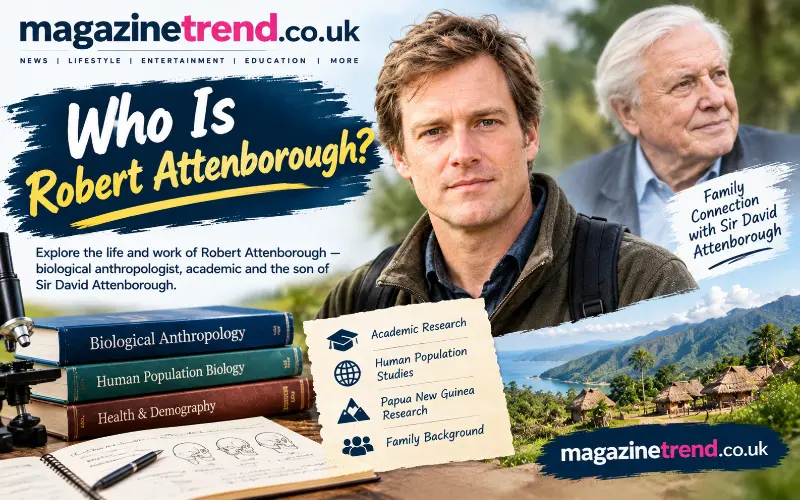
Robert Attenborough is an academic associated with biological anthropology, a field that examines human biology, evolution, population differences, and the relationship between people and their environments.
His professional profile differs significantly from the public career of Sir David Attenborough. David became internationally known through nature documentaries and environmental broadcasting, whereas Robert’s work is connected to research and higher education.
According to the University of Cambridge’s Department of Archaeology, Robert holds the position of Senior Fellow at the McDonald Institute for Archaeological Research. His profile also appears among the department’s biological anthropology specialists.
These university records provide a clearer picture of his professional identity than celebrity-focused articles that concentrate primarily on his family background.
For readers searching for Robert Attenborough, this distinction is important: his academic career is a substantial part of his identity, not simply an extension of the Attenborough family’s public reputation.
Is Robert Attenborough David Attenborough’s Son?
Robert Attenborough is widely identified in biographical coverage as the son of Sir David Attenborough and Jane Elizabeth Ebsworth Oriel. David Attenborough is internationally recognized for presenting landmark natural history documentaries and explaining the diversity of life on Earth.
However, Robert’s own professional path is different from his father’s. Rather than building a career in broadcasting, he has worked in biological anthropology and academic research.
This contrast makes the family connection particularly interesting. One member of the family became a familiar television personality, while Robert’s work is more closely associated with universities, scientific publications, and research into human populations.
It is also worth distinguishing Robert from other members of the extended Attenborough family. Richard Attenborough, the late actor and film director known for Gandhi and Jurassic Park, was David’s brother, not Robert’s professional counterpart.
The shared surname can lead to confusion in search results, so checking the person’s profession and institutional profile is useful when researching the family.
Robert Attenborough’s Academic Career
Robert Attenborough’s academic career is associated with biological anthropology and archaeological research. His university affiliations show that his work connects human biology with broader questions about population history, health, and adaptation.
University of Cambridge
The University of Cambridge lists Robert as a Senior Fellow at the McDonald Institute for Archaeological Research, within its Department of Archaeology.
The institute supports research into the human past through archaeology and related disciplines. Biological anthropology contributes to this work by examining human remains, biological variation, population history, and the relationship between people and their environments.
Robert’s Cambridge affiliation places him within an academic setting where researchers investigate long-term questions about human history and development.
Official reference: University of Cambridge — Department of Archaeology
Australian National University
Robert Attenborough is also listed by the Australian National University as an Honorary Senior Lecturer in its College of Arts and Social Sciences.
The university describes his more recent research as focusing on health, nutrition, and demography in Papua New Guinea. These subjects help researchers understand how biological, social, and environmental factors influence human populations.
His association with ANU is particularly relevant to understanding the geographical focus of his research and its contribution to the wider study of human population biology.
Official reference: Australian National University — Robert Attenborough
Related Post: Eileen Catterson: Biography, Age, Career and Marti Pellow
What Is Biological Anthropology?
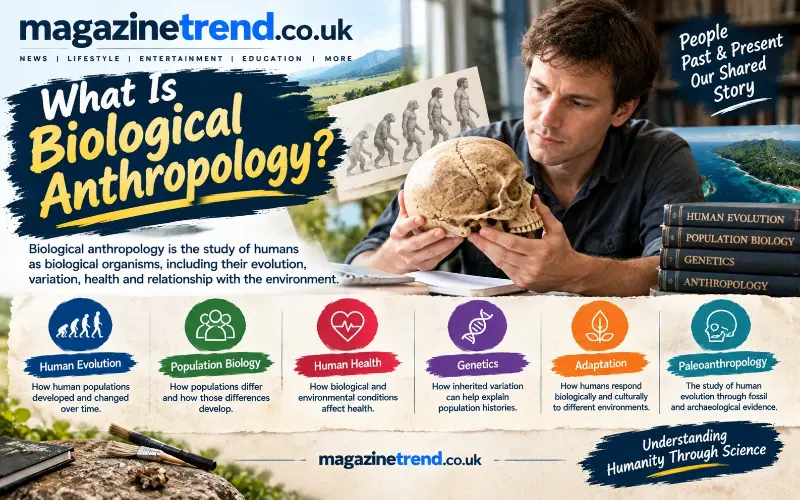
Biological anthropology is the study of humans as biological organisms, including their evolution, variation, health, and relationships with the environment.
The field draws on several areas of research:
- Human evolution: How human populations developed and changed over time.
- Population biology: How populations differ and how those differences develop.
- Human health: How biological and environmental conditions affect health.
- Genetics: How inherited variation can help explain population histories.
- Adaptation: How humans respond biologically and culturally to different environments.
- Paleoanthropology: The study of human evolution through fossil and archaeological evidence.
This background helps explain the academic context of Robert Attenborough’s work. His research interests connect biological anthropology with questions about the history and health of human populations.
Rather than focusing on celebrity or popular entertainment, this discipline uses scientific evidence to explore how humans have lived, adapted, and changed across generations.
Robert Attenborough’s Research in Papua New Guinea
Papua New Guinea is an important setting for research into human population history, health, genetics, and adaptation. Its diverse populations and environments provide researchers with opportunities to investigate how human communities have developed over time.
The Australian National University identifies health, nutrition, and demography in Papua New Guinea among Robert Attenborough’s recent research interests.
His academic publication record also includes work on biological anthropology and population genetics. For example, ANU’s research portal lists his contribution to the book Papuan Pasts: Cultural, Linguistic and Biological Histories of Papuan-Speaking Peoples.
More recent scholarly work involving Robert Attenborough and other researchers examines human genetics, regional demography, and adaptation in New Guinea.
These subjects are relevant because population history cannot always be understood through a single type of evidence. Researchers may combine biological data, genetics, historical information, and studies of local environments to investigate how populations changed over time.
Research into Papua New Guinea can also contribute to broader discussions about human diversity, disease, nutrition, and adaptation. Such studies need to be interpreted carefully and in their scientific context rather than reduced to oversimplified claims about individual communities.
Research references:
- ANU research portal — Robert Attenborough’s publications
Robert Attenborough’s Publications and Research Contributions
Robert Attenborough’s academic record includes contributions to scholarly publications on biological anthropology and the history of populations in New Guinea.
One example is his 2005 chapter, Introduction to the Chapters on Biological Anthropology and Population Genetics, published in Papuan Pasts: Cultural, Linguistic and Biological Histories of Papuan-Speaking Peoples.
The chapter introduces research areas concerned with biological variation and population genetics among Papuan-speaking peoples.
His more recent research contributions include work with Guy Jacobs and Pradiptajati Kusuma on human genetics and population history in New Guinea. These publications demonstrate that his academic interests extend to questions about regional demography, genetic diversity, and human adaptation.
Academic contributions are often less visible to the general public than television appearances or celebrity interviews. Nevertheless, publications are an important way researchers share evidence, explain their methods, and contribute to ongoing scientific discussions.
Readers who want to understand Robert’s work in greater detail can consult university research profiles and publication records rather than relying exclusively on short celebrity biographies.
Robert Attenborough and David Attenborough: Key Differences
Although Robert and David Attenborough are associated with the same family, their professional lives have followed different paths.
| Category | Robert Attenborough | Sir David Attenborough |
| Main professional identity | Academic and biological anthropologist | Naturalist, broadcaster and documentary presenter |
| Public profile | Primarily academic | Internationally recognized television personality |
| Main area of work | Human biology and population research | Natural history and wildlife documentaries |
| Institutional association | Cambridge and Australian National University | Longstanding broadcasting career, including the BBC |
| Research or communication focus | Human populations, health and demography | Wildlife, ecosystems and the natural world |
| Public visibility | Limited mainstream media coverage | Extensive international recognition |
The central difference is their professional focus. Robert’s career is connected to academic research, while David’s public career has focused on communicating the natural world to large audiences.
Both areas can contribute to public understanding, but they do so through different methods and audiences.
Robert Attenborough’s Family and Personal Life
Readers often search for information about Robert Attenborough’s family, relationships, children, and private life because of his reported connection to Sir David Attenborough.
However, Robert has a comparatively limited public profile outside academic settings. Detailed personal information is not consistently available through reliable institutional sources.
It is therefore important to separate established biographical context from speculation. His reported family relationship is discussed in published biographical coverage, but exact dates of birth, relationship details, household information, and other private matters should not be stated as facts without dependable evidence.
A lack of public information does not mean that a person has no notable personal experiences. It simply means that those details may not have been documented or made available for public reporting.
For a responsible biography, the strongest approach is to focus on his verified academic affiliations and research contributions while respecting the limits of available information about his personal life.
Robert Attenborough’s Age and Date of Birth
Robert Attenborough’s exact date of birth and age have not been reliably established in the university profiles reviewed for this article.
Some online biographies may provide estimates, but an estimate should not be presented as a confirmed birthday without a credible source.
Readers should be particularly cautious when a website publishes a precise age without identifying an official record, a first-hand interview, or another dependable source.
For now, it is more accurate to acknowledge that his exact age is not confirmed in the sources used here than to repeat a potentially incorrect number.
What Is Robert Attenborough’s Net Worth?
There is no reliable, independently verified estimate of Robert Attenborough’s personal net worth in the sources reviewed.
Academic job titles and university affiliations do not provide enough information to calculate someone’s wealth. Net worth depends on personal assets, liabilities, income, investments, and other financial details that are generally private.
Celebrity biography websites sometimes publish financial estimates without explaining their methodology. Such figures should be treated cautiously unless supported by credible financial disclosures or other reliable documentation.
For this reason, a specific net-worth figure would be speculative. His academic work and research record provide more meaningful, verifiable information about his professional life.
Related Post: Reginald Williams: NFL Career, Biography & Legacy
Why Is Robert Attenborough Searched Online?
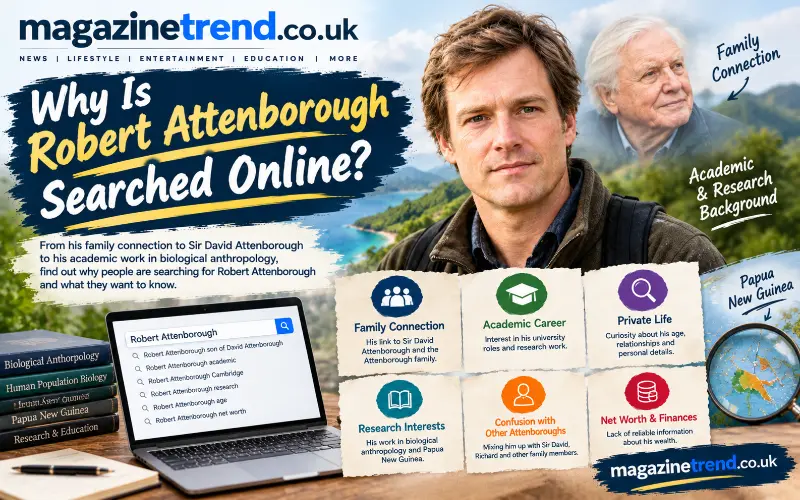
Several factors may explain why people search for Robert Attenborough.
His family connection: Readers interested in Sir David Attenborough may want to learn about his children and their professional lives.
His academic career: University profiles and research publications provide information for people interested in biological anthropology.
His relatively private profile: Limited mainstream coverage can lead readers to seek more detailed biographies.
Confusion about the Attenborough name: The extended family includes people associated with broadcasting, acting, film direction, and academia. This can cause unrelated professional achievements to be incorrectly attributed to the wrong person.
Interest in his research: Work on human population history, health, genetics, and Papua New Guinea may attract readers researching anthropology and related disciplines.
A useful biography should address these questions directly while making clear which details are documented and which remain uncertain.
FAQs
Who is Robert Attenborough?
Robert Attenborough is a biological anthropologist and academic associated with the University of Cambridge and the Australian National University. His research interests include human population biology, health, nutrition, and demography.
Is Robert Attenborough David Attenborough’s son?
Biographical coverage identifies Robert as the son of Sir David Attenborough and Jane Elizabeth Ebsworth Oriel. Robert has pursued an academic career rather than following his father’s path into television broadcasting.
What does Robert Attenborough do for a living?
He is associated with academic research and higher education. Cambridge lists him as a Senior Fellow at the McDonald Institute for Archaeological Research, while ANU lists him as an Honorary Senior Lecturer.
What is Robert Attenborough known for?
He is known for his academic work in biological anthropology and research related to human populations, health, and demography, particularly in Papua New Guinea.
Where does Robert Attenborough work?
The University of Cambridge lists him as a Senior Fellow at the McDonald Institute for Archaeological Research. The Australian National University also lists him as an Honorary Senior Lecturer.
What does Robert Attenborough research?
His research interests include biological anthropology, human population biology, health, nutrition, demography, and population history in Papua New Guinea.
Is Robert Attenborough a television presenter like his father?
His documented professional profile is academic rather than focused on television presenting. Sir David Attenborough is internationally known for natural history documentaries, while Robert’s work is associated with university research.
How old is Robert Attenborough?
His exact date of birth has not been reliably confirmed in the sources reviewed. A precise age should not be published as fact without dependable evidence.
What is Robert Attenborough’s net worth?
No reliable public estimate of his personal net worth has been established in the sources reviewed. Figures published without transparent evidence should be treated with caution.
Has Robert Attenborough published academic research?
Yes. His academic record includes contributions to publications on biological anthropology and population genetics, including work on the history and biology of populations in New Guinea.
Conclusion
Robert Attenborough has developed an academic profile distinct from the internationally recognized broadcasting career of his father, Sir David Attenborough. His university affiliations and scholarly publications connect him to biological anthropology, human population biology, and research into health and demography in Papua New Guinea.
Although public curiosity about his family background continues, the most dependable information about Robert comes from university records and academic publications. His career demonstrates that a person associated with a famous family can build a professional identity in a field far removed from entertainment and television.
For readers researching Robert Attenborough, focusing on documented academic positions and research contributions offers a more accurate picture than relying on unsupported claims about his age, private life, or finances.

2 thoughts on “Robert Attenborough: Biography, Academic Career and Family”