
Marshmello is one of the most recognisable names in electronic dance music, known for his energetic performances, catchy productions and signature white marshmallow-shaped helmet. While many DJs build their public identities around their faces, personal lives and celebrity appearances, Marshmello has created a distinctive brand that allows his music and character to take centre stage.
His catalogue includes internationally successful songs such as “Alone,” “Silence,” “Wolves,” “Friends” and “Happier.” He has also worked with artists from different musical backgrounds, helping him reach audiences beyond traditional electronic dance music. Over the years, his work has expanded into pop, hip-hop, Latin music and country-influenced collaborations.
But who is Marshmello behind the mask? What is his real name, how did he become famous, and how much has his career contributed to his wealth?
This biography explores Marshmello’s background, breakthrough, major releases, collaborations, private identity and continuing influence on modern music.
Marshmello at a Glance
| Detail | Information |
| Stage name | Marshmello |
| Real name | Christopher Comstock |
| Date of birth | May 19, 1992 |
| Age in 2026 | 34 years |
| Birthplace | Philadelphia, Pennsylvania, United States |
| Nationality | American |
| Profession | DJ, record producer and electronic music artist |
| Main genres | Electronic dance music, future bass, trap and pop |
| Years active | Publicly established as Marshmello in 2015 |
| Known for | His white helmet, electronic productions and collaborations |
Biographical sources identify Marshmello as Christopher Comstock, an American DJ and record producer born in Philadelphia.
Related Post: BigXthaPlug: Real Name, Age, Songs, Albums and Career
Who Is Marshmello?
Marshmello is an American electronic music producer and DJ who rose to international prominence during the mid-2010s. His sound combines electronic beats, melodic synths, bass-heavy production and vocal performances from established singers and emerging artists.
The most distinctive feature of his public identity is his oversized white helmet, designed to resemble a smiling marshmallow. The helmet makes him immediately recognisable on festival stages, in music videos and across social media.
Rather than treating the helmet as a temporary costume, Marshmello made it central to his professional identity. The character has become an important part of his branding, merchandise, live performances and relationship with fans.
His music has also evolved considerably since his early releases. Although electronic dance music helped establish his reputation, his collaborations demonstrate a willingness to work across genres and experiment with different vocal styles.
What Is Marshmello’s Real Name?
Marshmello’s real name is Christopher Comstock. His identity became a major subject of speculation during his early career because he performed behind a helmet and rarely relied on conventional celebrity publicity.
His name has also been associated with the electronic music alias Dotcom. Music databases identify Comstock as the artist behind Marshmello, although his public performances continue to use the masked persona.
The mystery surrounding his identity contributed to public curiosity, but it is only one part of his success. His sustained popularity has depended on music releases, collaborations, touring and a recognisable visual brand.
The helmet also allows the character to remain visually consistent even as his musical direction changes. Fans can recognise Marshmello immediately, whether he is performing an EDM festival set or appearing in a collaboration with an artist from another genre.
Marshmello’s Early Career and Breakthrough
Marshmello began attracting attention in 2015, when he shared electronic tracks and remixes online. Music platforms made it easier for emerging producers to reach listeners and other musicians without first securing a major traditional recording contract.
His early releases caught the attention of established figures in electronic music. Support from fellow producers helped his music circulate among dance music audiences, while live appearances introduced his sound to festival crowds.
In 2016, he released Joytime, his debut studio album. The project helped establish a larger collection of original music rather than leaving his reputation dependent on individual singles. It also included “Keep It Mello,” featuring Omar LinX.
His early success was built on a combination of accessible melodies, energetic production and an identity that stood apart from other performers. The helmet attracted attention, but the music gave listeners a reason to return.
The Growth of the Joytime Albums
The Joytime series became an important part of Marshmello’s discography. Joytime II followed in 2018, and Joytime III arrived in 2019, showcasing his continuing work in electronic music.
These albums also demonstrated that he could build a catalogue alongside his increasingly successful collaborations. His career was no longer defined by one viral release or one distinctive costume; he was developing a long-term presence in the dance music industry.
Marshmello’s Biggest Songs and Collaborations
Marshmello’s popularity has grown through a mixture of solo productions and collaborations with singers from different genres. Working with established vocalists has helped his tracks reach listeners who might not regularly follow electronic music.
| Song | Collaborator or featured artist | Why it matters |
| “Alone” | Marshmello | An early signature track that helped establish his sound |
| “Silence” | Khalid | Combined electronic production with soulful vocals |
| “Wolves” | Selena Gomez | Expanded his reach among mainstream pop listeners |
| “Friends” | Anne-Marie | A prominent pop and dance collaboration |
| “Happier” | Bastille | Became one of his most recognisable crossover hits |
| “Miles on It” | Kane Brown | Demonstrated his interest in electronic and country crossover music |
These songs reflect the range of Marshmello’s production career. “Silence” and “Wolves” connected him with major pop audiences, while “Happier” became a particularly prominent collaboration. Later work with country artist Kane Brown illustrated his continued interest in combining electronic production with other musical traditions.
Why “Happier” Became So Popular
“Happier,” featuring Bastille, stands out because it pairs electronic production with an emotionally direct vocal performance. Rather than relying solely on a festival-style drop, the song builds around a memorable melody and a story that listeners can connect with.
That balance helped it appeal to both dance music fans and mainstream pop audiences. It also reinforced Marshmello’s reputation as a producer capable of supporting a song’s emotional message rather than simply supplying its instrumental arrangement.
Collaborations Beyond Electronic Music
Marshmello has worked with musicians from pop, hip-hop, Latin music and country. His 2023 album Sugar Papi explored Latin-influenced music, while later collaborations included Kane Brown and Jelly Roll. His catalogue has therefore continued to develop beyond the sound associated with his earliest releases.
Related Post: Roz Varon: Biography, Career, Retirement and Life After ABC7
Marshmello’s Albums and Musical Evolution
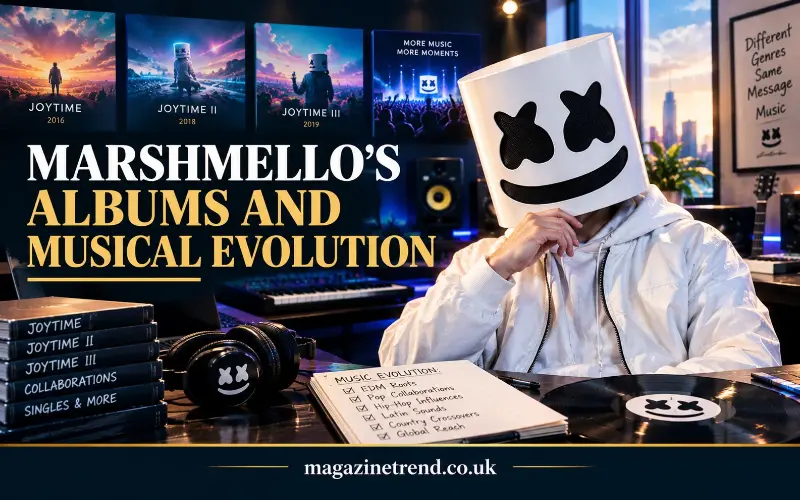
Marshmello’s albums provide a clearer picture of his development than his singles alone. They show how he has maintained an electronic music foundation while exploring different production styles and collaborators.
| Album or project | Release year | Significance |
| Joytime | 2016 | Introduced his debut album-era sound |
| Joytime II | 2018 | Continued his melodic electronic style |
| Joytime III | 2019 | Expanded his collaborations and production range |
| Shockwave | 2021 | Received a Grammy nomination for Best Dance/Electronic Album |
| Sugar Papi | 2023 | Explored Latin music and crossover collaborations |
His album Shockwave received a Grammy nomination in the Best Dance/Electronic Album category for the 2022 awards. The recognition marked an important milestone in his career.
Sugar Papi represented another shift, bringing Latin artists and sounds into his work. Rather than remaining tied to a single genre, Marshmello has repeatedly used collaborations to test different musical directions.
This flexibility is one reason his catalogue appeals to different listener groups. Fans drawn to energetic electronic tracks can explore one part of his discography, while pop and Latin music listeners may discover him through collaborations.
Why Does Marshmello Wear a Helmet?
Marshmello’s helmet is more than a stage accessory. It is the central visual element of his artistic persona and one of the most recognisable symbols in contemporary electronic music.
The white, rounded headpiece features black eyes and a simple smiling mouth. Its cartoon-like design creates a contrast with the loud, visually elaborate environments in which DJs often perform.
The helmet also changes the focus of his public appearances. Audiences see the character rather than a conventional celebrity portrait, allowing the performer to maintain a degree of separation between his public brand and private life.
This approach has helped create a consistent identity across live shows, promotional campaigns, merchandise and online videos. The design is simple enough to be remembered quickly, yet distinctive enough to separate him from other electronic artists.
It would be misleading, however, to attribute his success to the helmet alone. His music, collaborations, performances and business decisions have all contributed to his standing in the industry.
Marshmello’s Net Worth: How Much Is He Worth?
Marshmello’s exact net worth has not been publicly verified through a comprehensive financial disclosure. Celebrity wealth websites publish estimates, but these figures can vary considerably and should not be treated as confirmed financial records.
His career offers several potential income sources: music streaming, songwriting and production, recording deals, live performances, merchandise, licensing and commercial partnerships. Artists with international audiences may also earn revenue when their music is used in films, television, games or advertising, depending on the relevant rights and agreements.
| Potential income source | How it may generate revenue |
| Music streaming | Royalties from plays on digital platforms |
| Live performances | Fees from festivals, concerts and private events |
| Music production | Payments and royalties connected to recording projects |
| Brand partnerships | Commercial campaigns and sponsored collaborations |
| Merchandise | Sales of branded clothing and products |
| Licensing | Fees or royalties for authorised uses of music |
These are general music-industry revenue categories, not a breakdown of Marshmello’s personal finances. Without verified financial statements, a precise figure would be speculative.
His global recognition and extensive catalogue provide a basis for a successful commercial career, but earnings and net worth are not interchangeable. Expenses, taxes, management fees, business investments and contractual arrangements all affect the amount an artist ultimately retains.
Related Post: Julian Lennon: Biography, Music,Family and Life Today
Marshmello’s Personal Life and Relationships
Despite his public profile, Marshmello has kept much of his personal life away from the centre of his musical brand. His masked persona encourages attention toward his performances and releases rather than his everyday appearance.
Fans have frequently searched for details about his relationships, family and life outside music. However, information circulating online is not always supported by reliable reporting, and rumours should not be presented as established facts.
His public career offers more verifiable material: music releases, collaborations, festival appearances and official announcements. These provide a stronger foundation for a biography than speculation about private relationships.
The distinction between a public persona and a private individual is particularly relevant for an artist whose identity has been closely associated with anonymity. Marshmello’s helmet has made him highly visible while allowing parts of his personal life to remain outside his performance brand.
Marshmello’s Influence on Modern Music and Entertainment
Marshmello’s career illustrates how electronic music producers can build mainstream recognition through digital platforms, distinctive branding and cross-genre collaborations.
His work with singers such as Khalid, Selena Gomez, Anne-Marie and Bastille brought his production to audiences beyond the traditional EDM scene. Later projects expanded that approach into Latin and country-influenced music.
He has also participated in entertainment experiences outside conventional concerts. His 2019 Fortnite in-game performance became a notable example of a music artist using a video game environment to reach an audience. The event helped demonstrate how live music experiences could extend into interactive digital spaces.
His career reflects several wider industry changes:
- Digital discovery: Online platforms helped his early releases find listeners.
- Visual branding: The helmet created an identity that was easy to recognise.
- Cross-genre production: Collaborations connected electronic music with pop and other styles.
- Digital entertainment: Gaming and online experiences opened additional ways to reach fans.
- Multiple revenue streams: Music, touring, licensing and commercial projects can work together to support an artist’s business.
Marshmello’s significance lies not only in individual hit songs, but also in how he has combined music, visual identity and digital culture into a recognisable entertainment brand.
What Is Marshmello Doing Now?
Marshmello continues to release music and work across genres. His more recent catalogue includes projects and collaborations extending into country-influenced music, including “Another Drink” with Kelsea Ballerini in 2026, according to AllMusic’s current artist discography.
His official Japanese artist pages also list ongoing releases and appearances, reflecting continued activity in the international music market.
His current direction is best described as an ongoing expansion of his established sound rather than a complete departure from electronic music. He continues to use dance production as a foundation while exploring new vocal styles and audiences.
For fans, this means his work is not limited to the festival tracks that first made him famous. His more recent collaborations show an artist willing to experiment while retaining the recognisable production identity that helped establish his career.
Frequently Asked Questions About Marshmello
1. What is Marshmello’s real name?
Marshmello’s real name is Christopher Comstock. He is an American DJ and record producer known professionally for his masked stage persona.
2. How old is Marshmello in 2026?
Marshmello was born on May 19, 1992. He turned 34 in May 2026.
3. Why does Marshmello hide his face?
He performs wearing a distinctive white helmet that forms the centre of his public identity. The character helps distinguish his brand from conventional celebrity presentation and keeps attention on his music and performances.
4. What are Marshmello’s most famous songs?
Some of his best-known songs include “Alone,” “Silence,” “Wolves,” “Friends” and “Happier.” These releases helped him reach audiences across electronic music and mainstream pop.
5. What is Marshmello’s net worth?
His exact net worth has not been publicly verified. Online estimates vary, so any specific figure should be treated as an estimate rather than confirmed financial information.
6. Is Marshmello still making music?
Yes. His discography includes releases and collaborations from 2026, including “Another Drink” with Kelsea Ballerini, showing that he remains active in music.
Conclusion
Marshmello has built a distinctive career by combining electronic music production with an instantly recognisable visual identity. From his early online releases and Joytime albums to collaborations with international pop stars and artists from other genres, his career demonstrates an ability to adapt without abandoning his musical foundations.
His real name, Christopher Comstock, is now widely reported, but the helmet remains central to his public persona. More importantly, his catalogue shows that his success is about more than a mysterious identity: it reflects years of releases, collaborations and experimentation.
As his music continues to cross genre boundaries, Marshmello remains a notable figure in modern electronic entertainment—an artist whose work connects dance music, pop culture and digital experiences.
