
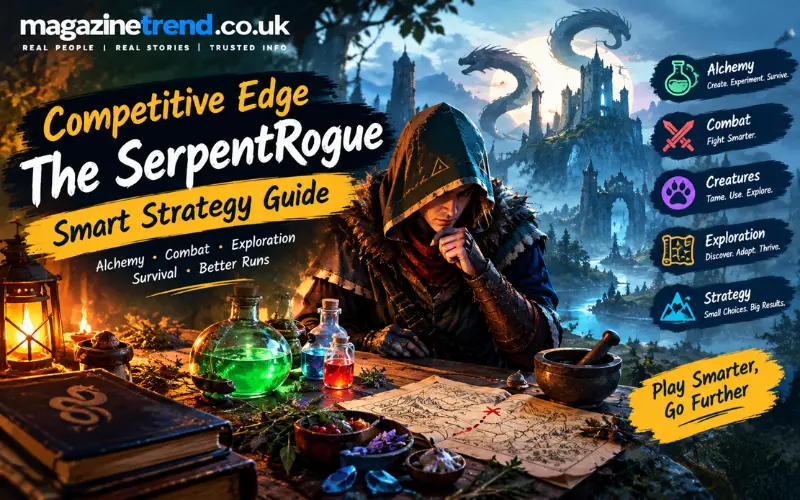
If you are searching for the competitive edge of the serpentrogue, you may be wondering whether “Competitive Edge” is an official ability, ranked mode, perk, or hidden feature in The Serpent Rogue.
It is not.
In this game, the phrase is better understood as the strategic advantage you gain by learning its systems and making better decisions. The Serpent Rogue is a single-player action-adventure built around alchemy, exploration, creature taming, crafting, combat, and cause-and-effect systems.
The real advantage comes from understanding what to do before danger arrives.
What Does Competitive Edge The SerpentRogue Mean?
The simplest explanation is:
Competitive edge in The Serpent Rogue means becoming more efficient at handling the game’s systems.
There is no conventional PvP ladder where you compete against another player. Instead, you are dealing with dangerous creatures, corruption, limited resources, exploration risks, and the consequences of your own decisions.
That changes what “competitive edge” means.
A strong player does not necessarily attack faster. They understand:
- Which ingredients are worth researching
- Which potions are useful
- When to fight and when to avoid combat
- How to manage resources
- How creatures can help
- How environmental actions create consequences
- When exploration is worth the risk
The result is a style of play based on knowledge, preparation and adaptability.
The Serpent Rogue at a Glance
| Feature | Details |
| Game | The Serpent Rogue |
| Developer | Sengi Games |
| Publisher | Team17 |
| Genre | Action-adventure / RPG / sandbox |
| Main character | The Warden |
| Core system | Alchemy and potion crafting |
| Multiplayer competition | No traditional PvP mode |
| Main activities | Exploration, crafting, combat, creature taming |
| Release date | April 26, 2022 |
| Platforms | PC, Nintendo Switch, PlayStation 5, Xbox Series X/S |
The official game descriptions emphasize alchemy, exploration, creature interactions and the consequences of player actions.
Is “Competitive Edge” an Official Feature?
No.
The phrase competitive edge the serpentrogue is not the name of an official skill, weapon, perk or game mode in the game’s official descriptions.
This distinction matters because someone searching the phrase could assume that there is a menu option or special ability called Competitive Edge.
There isn’t.
Instead, the phrase works as a useful description for player mastery.
Think of it this way:
| New Player | Experienced Approach |
| Collects everything | Prioritizes useful resources |
| Uses potions randomly | Learns potion effects |
| Fights immediately | Evaluates the encounter first |
| Explores without a plan | Sets a clear objective |
| Ignores consequences | Watches how actions affect the world |
| Repeats the same mistake | Changes strategy after failure |
| Treats creatures as enemies | Looks for opportunities to tame them |
That difference in decision-making is where the practical advantage comes from.
Related Post: Befitnatic Website Explained: About the Site and Its Content
Why Alchemy Is the Biggest Advantage

Alchemy is one of the most important systems in The Serpent Rogue.
The Warden can collect ingredients, research them and experiment with combinations to create potions. Those potions can then be used to approach problems in different ways.
This makes knowledge extremely valuable.
A player who understands ingredients has more options than someone who simply relies on direct combat.
A Better Alchemy Routine
Instead of treating every ingredient as something to consume immediately:
- Collect unfamiliar ingredients.
- Research their properties.
- Record useful effects mentally or in your notes.
- Experiment with combinations when you have enough resources.
- Keep useful recipes available for dangerous situations.
- Avoid wasting rare materials on unnecessary experiments.
The goal is not to memorize everything at once.
The goal is to gradually turn experimentation into reliable knowledge.
Preparation Creates a Real Advantage
Preparation is one of the easiest ways to improve your runs.
Before entering a dangerous area, ask yourself:
- What am I trying to accomplish?
- Which items do I actually need?
- Do I have a useful potion?
- Is my equipment appropriate?
- Am I carrying anything that would be painful to lose?
- Do I have a reason to fight every creature I encounter?
These questions can prevent unnecessary losses.
A player who enters an area with a clear objective can often make better decisions than someone who simply explores until something goes wrong.
Resource Management Matters More Than Hoarding
Having lots of items does not automatically mean you are prepared.
In fact, carrying too much can encourage poor decisions.
A better approach is to divide resources into three categories:
| Category | What to Do |
| Essential | Protect and prioritize |
| Useful | Carry when the situation justifies it |
| Replaceable | Don’t risk a run just to save it |
This creates a more controlled inventory.
The key question is not “Can I carry this?”
It is:
“Is carrying this worth the risk?”
That mindset can make exploration more efficient.
Related Post: Catherine Panagiotopoulos: Jason Varitek’s Wife & Family Now
Learn Before You Fight

Combat is important, but not every encounter has to become a battle.
Before attacking, consider:
- What type of enemy is this?
- What resources will the fight consume?
- Can you avoid the encounter?
- Do you have a useful potion?
- Is there a better position?
- Would a creature or environmental interaction help?
This is especially important in a game where actions can create consequences.
Sometimes the best combat decision is preparation.
Sometimes it is avoidance.
Sometimes it is using alchemy instead of a weapon.
Creature Taming Can Expand Your Options
Creature interaction is another system that separates The Serpent Rogue from a straightforward combat game.
The official descriptions highlight the ability to tame and befriend creatures.
That means a creature does not always have to be viewed as something that must be defeated.
Learning how creature interactions work can give you another way to approach dangerous areas.
Instead of asking only:
“How do I kill this?”
try asking:
“Can this creature help me?”
That change in thinking is an important part of mastering the game’s systems.
Understand Cause and Effect
One of the game’s distinctive ideas is that actions can produce unexpected consequences.
For example, the official descriptions explain that leaving too many creatures together can attract Reapers, failing to deal with fallen creatures can attract Ghouls, and excessive item accumulation can attract vermin.
That means the environment is not simply decoration.
Your actions can influence what happens next.
The Practical Lesson
Don’t only think about the immediate result.
Think one step ahead.
| Immediate Action | Possible Strategic Question |
| Leave items behind | Could this create another problem? |
| Gather many creatures | What might their presence attract? |
| Ignore fallen creatures | Could this affect the area later? |
| Enter a dangerous region | What do I need before going in? |
| Use a valuable potion | Is this the right moment to spend it? |
This habit of anticipating consequences can improve your overall efficiency.
Exploration: Go With a Purpose
Random exploration can be entertaining, but purposeful exploration is often more efficient.
Before leaving a safe area, decide what you want from the trip.
For example:
- Find a specific ingredient
- Research an unknown resource
- Complete a task
- Search a particular area
- Find useful equipment
- Investigate a dangerous location
Once the objective is complete, consider returning rather than continuing simply because you are already there.
This reduces unnecessary exposure to danger.
Related Post: Elizabeth Fogle: The Private Story Behind Jared Fogle’s Ex
The Best Strategy Is Not Always the Fastest

Players sometimes assume that the best strategy means completing everything as quickly as possible.
That is not necessarily true here.
A fast decision can become a bad decision if it creates a larger problem later.
For example:
Rush → Fight → Lose resources → Need more resources → Take bigger risks
A more controlled approach can look like:
Prepare → Explore → Research → Use resources carefully → Return safely
The second approach may feel slower, but it can reduce wasted attempts.
Common Mistakes That Remove Your Advantage
If you want to develop a real competitive edge the serpentrogue, avoid these common habits.
Fighting Everything
Not every enemy deserves your resources.
Ignoring Alchemy
Treating potion crafting as optional means ignoring one of the game’s central systems.
Carrying Too Much
More items do not automatically mean more security.
Repeating Failed Strategies
If the same approach repeatedly produces the same result, change something.
Ignoring Environmental Consequences
The world reacts to certain actions, so pay attention to cause and effect.
Exploring Without an Objective
A clear goal can make each expedition more productive.
Saving Nothing for Emergencies
Using your best resources immediately can leave you unprepared when the situation becomes dangerous.
A Simple Competitive Edge Routine
You do not need an extremely complicated strategy.
Use this basic routine:
Before Leaving
- Check your supplies.
- Decide your objective.
- Prepare useful potions.
- Remove unnecessary items.
During Exploration
- Watch your surroundings.
- Research useful ingredients.
- Avoid unnecessary fights.
- Look for creature opportunities.
- Pay attention to environmental changes.
Before Combat
- Identify the threat.
- Consider alternatives to fighting.
- Use preparation to reduce risk.
- Don’t waste valuable resources unnecessarily.
After a Failed Run
Ask:
- What caused the failure?
- Which decision created the problem?
- Could preparation have prevented it?
- What will I change next time?
That final step is where experience becomes useful knowledge.
What Actually Gives You an Edge?
There is no single secret trick.
The strongest advantage comes from combining several small improvements.
| System | What to Improve |
| Alchemy | Research and understand ingredients |
| Combat | Choose fights carefully |
| Exploration | Travel with an objective |
| Resources | Carry only what you need |
| Creatures | Learn when taming is useful |
| Environment | Watch cause-and-effect reactions |
| Preparation | Plan before entering danger |
| Learning | Adapt after mistakes |
The more these systems work together, the more controlled your gameplay becomes.
FAQs
What is competitive edge the serpentrogue?
It is a phrase used to describe the strategic advantage gained by understanding The Serpent Rogue‘s systems. It is not an official named ability.
Does The Serpent Rogue have a competitive multiplayer mode?
The game is presented as a single-player experience rather than a traditional PvP title. Its challenge comes from exploration, combat, alchemy, creatures and environmental consequences.
Is Competitive Edge a skill in The Serpent Rogue?
No. There is no official evidence that “Competitive Edge” is a named skill or perk.
What is the most important system to learn?
Alchemy is one of the game’s central systems. Learning how ingredients and potion crafting work can give you more options when dealing with difficult situations.
How can beginners get better at The Serpent Rogue?
Start by learning ingredients, avoiding unnecessary fights, managing resources and paying attention to cause-and-effect mechanics.
Should you fight every enemy?
No. Consider whether the reward justifies the resources and risk involved.
Can creatures be useful?
Yes. Creature taming and interaction are important parts of the game’s design, giving players alternatives to simply fighting everything.
Why is resource management important?
Resources affect how prepared you are for future encounters. Carrying or spending items without considering their future value can make later situations harder.
What makes an experienced player different?
Experience allows players to recognize patterns, prepare earlier, avoid unnecessary risks and adapt after mistakes.
Is there one “best” strategy for The Serpent Rogue?
There is no single strategy that fits every situation. The game’s systems encourage experimentation, so a flexible approach is generally more useful than relying on one fixed tactic.
Conclusion
The competitive edge the serpentrogue search phrase can sound like it refers to a hidden game feature, but the more useful interpretation is much simpler: learn the systems and make smarter decisions.
Alchemy, resource management, creature interactions, exploration and cause-and-effect mechanics all contribute to better play.
The biggest improvement is not necessarily faster combat. It is understanding what a situation requires before committing resources to it.
Research ingredients. Prepare before dangerous trips. Avoid fights that offer little value. Pay attention to what your actions cause. And when a run fails, use the experience to change your next decision.
That is the real advantage in The Serpent Rogue: knowledge that compounds from one decision to the next.
